
5-Year Maze: Why Hospital IT Software Fail and How to Prevent It

Most hospital IT software is quietly failing. Not on launch day but actually on day 1,827. Year one almost always looks like a success. Like a garden left untended, a system that launched perfectly begins to unravel by year three.
But why that happens and how forward-thinking hospitals are solving it.
Year 3: Silent IT Killers (What Happens in Year 3)
By the third year, the original launch team has moved on. Updates have slowly changed the software, and leadership starts noticing that promised cost-savings haven’t materialized. This happens because of three silent problems:
Polluted Data Erodes Trust.
Without strict rules, tiny errors snowball across thousands of users, zero rules. Duplicate patient files, inconsistent billing codes, and polluted reports mean leadership can no longer trust what the system tells them.
Integrations Break and Bury Your IT Team.
Most hospitals don’t run on one software; a dozen tools duct-taped together will eventually fall apart. Every vendor update risk breaking a custom connection, and your IT team shifts from innovating to just keeping the lights on.
Workarounds Replace the System.
A new regulation requires an extra step. When staff can’t adapt to the software, they route around it. Excel sheets and paper checklists creep back in, and the system in use by year three is no longer the one you designed.
Year 5 Reckoning
By year five, the cumulative damage surfaces at the top. Patient wait times haven’t improved; billing cycles are still slow, and the IT budget is consumed entirely by maintenance. Most hospitals respond by falling into the Patch-and-Pray Cycle, buying more software to fix the problem, adding new integrations and data silos that compound the dysfunction they were meant to solve.
How to Build for Long-Term Value
The hospitals that see a return on their IT investments five years later do not necessarily spend more money. They spend it differently, focusing on IT architectural discipline from day one.
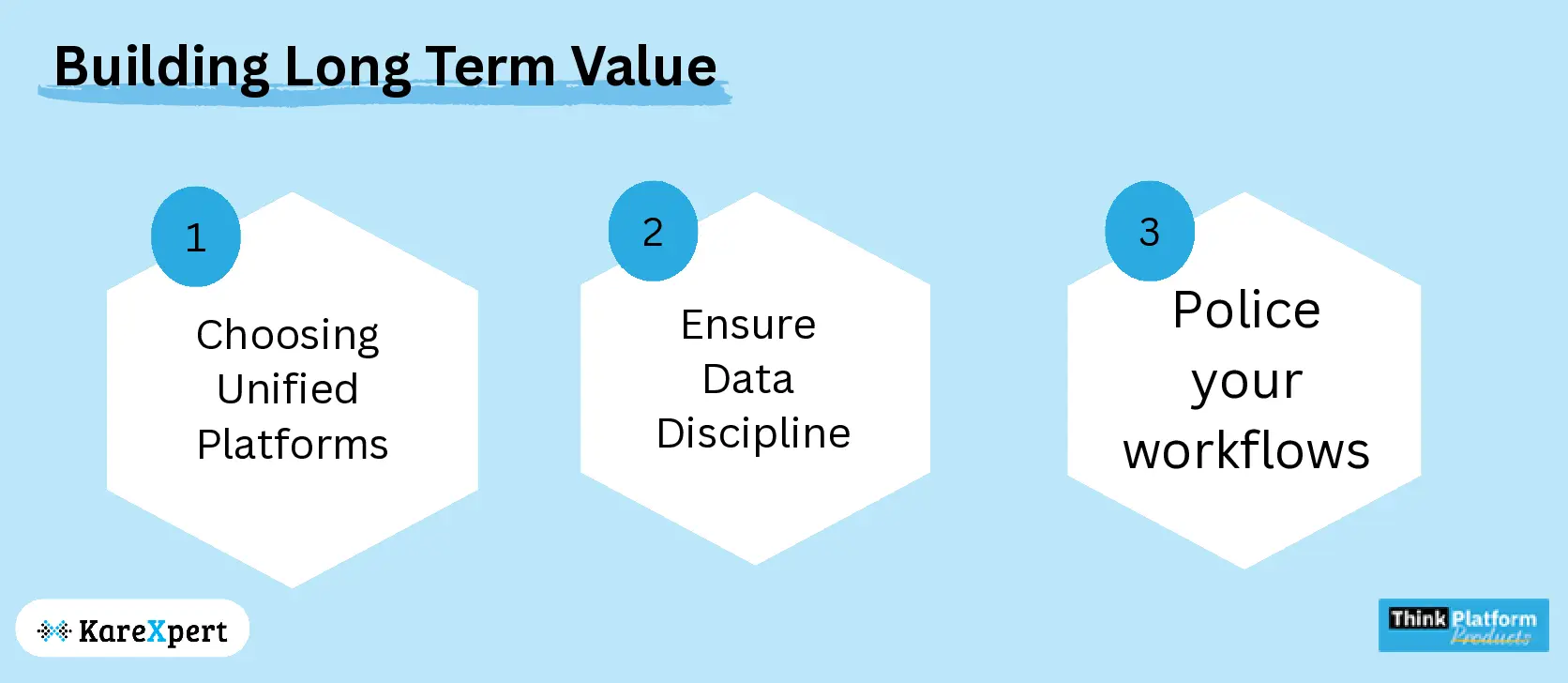
1. Choose Unified Platforms Over “Duct-Tape” Software.
Every time you connect two separate pieces of software, you create a future breaking point. Successful hospitals favor IT architectural consolidation, keeping all core modules (pharmacy, billing, EHR) on a single database. This eliminates the integration trap entirely, freeing the IT team to focus on patient care instead of fixing broken APIs.
2. Enforce Strict Data Discipline.
Treat data as your most valuable asset. Assign clear owners to data definitions and do not allow the master patient index or clinical terminology to fragment across departments. A unified platform naturally supports this by acting as a single source of truth.
3. Police Your Workflows.
Treat your IT environment as a living ecosystem. When workflows need to change, don’t allow rogue spreadsheets. Use flexible, modular software that can be officially reconfigured to match new clinical realities, keeping everyone working inside the same software.
Conclusion
The IT investments that fail rarely fail because the technology was bad; they fail from a weak foundation and the lack of discipline to maintain it. The system you build this year will determine whether a patient in year five gets the right diagnosis or waits three extra days because of a duplicate file. The architecture decision is never just a technology decision. It is a patient care decision.