
The Real Reason Patients Are Leaving: It’s Not Your Doctors—It’s Your Systems

Introduction: What No One Wants to Hear
So when a patient walks out and never returns, hospitals often don’t go very deep with their assumptions: Was the doctor too brusque? Was the intervention ineffective? Was the billing too high? But the underlying reason patients are leaving might be much less personal and much more structural. They’re not fleeing healthcare; they’re fleeing antiquated, uncoordinated systems that make care frustrating, impersonal, and inefficient.
In 2025, patient loyalty is not only built in the consultation room — it begins with every click, every form, every wait.
This Is the New Front Desk; It Is Systems.
It used to be that a smiling receptionist and a well-run OPD was all that defined a hospital’s brand. Now, that “front desk” is online. Patients first encounter your hospital through its appointment booking portals, online registration, teleconsultation platforms, and follow-up reminders. And if those systems are clumsy, confusing, or absent, the qualifications of your doctors count for little. Patients will leave.
Imagine a patient attempting to schedule an appointment online. She clicks over to the website where there’s no clear call-to-action, broken forms, and non-responsive mobile design. Or picture someone calling your helpline, only to get passed around because your departments aren’t integrated.
Those are not petty nuisances. These are digital-age deal-breakers.
Fragmentation: When It Comes Across Like Neglect
Fragmented systems don’t merely aggravate patients — they erode trust. Patients want their data to come with them. They expect the doctor they visit today to have access to the tests taken yesterday. When it doesn’t, it can feel like a betrayal.
A lab test that doesn’t arrive in time to see the physician. A prescription that is unfillable due to pharmacy software not syncing with the EMR. An imaging scan that must be physically routed from one department to the next. These are not IT problems; they are patient experience problems.
And get this: The majority of patients won’t complain. They’ll simply disappear.
Death by a Thousand Clicks
Even if you had world-class medical expertise in house, you’d still lose patients if your digital experience was a labyrinth. Having to log in to separate portals for lab reports, appointment scheduling, billing, and medical history is not only frustrating — it should be a red flag that your hospital is falling behind.
This digital detritus wastes time, breeds mistakes, and gives the impression that nobody cares. How can a patient trust your clinical accuracy if your systems can’t even agree on their fundamental facts?
What Patients Really Want: Simplicity, Continuity, Transparency
Patients don’t want miracles. They want clarity. They want to:
– Schedule appointments without a phone call.
– Submit forms one time, not three times in three departments.
– Receive digital test results — no need to beg someone to print it out.
– Automatically be reminded of follow-ups.
– Understand what they’re paying for and why.
This is not high-end luxury. That’s just common digital hospitality. And if your systems cannot deliver it, patients will find providers that can.
The Doctor Isn’t the Problem
It’s time we stop blaming doctors when scores of patient satisfaction fall. In these cases, the clinical care is frequently excellent. The diagnosis is accurate. The treatment is effective. But the end-to-end experience is held together by kludged-up tools, needless friction, and black box workflows.
And increasingly, doctors are burnt out by bad systems. They spend more time fighting with their interfaces than they do with patients. When systems break down, everyone loses: the doctor, the administrator, and worst of all — the patient.
A Tale of Two Clinics
Clinic A has a fancy UI for its patient portal. It’s integrated with the EMR, appointment scheduler, pharmacy, and billing. Patients receive automated reminders, instant report access, and personalized updates.
Clinic B has legacy software, and patients have to call for literally everything. Records are printed. Appointments get lost. Test results take days. The staff spends time fixing what systems break due to its patching-up strategy.
Both clinics have very good doctors. But one will consistently keep patients.
The difference is not medical skill; it’s operational experience.
The Wake-Up Call: Patients Are Now Shoppers
Patients put up with an inefficient system in the past because there was no other option. Today, boutique, digital-first clinics, home-based care, and AI-assisted platforms are reshaping the rules. Healthcare is now a consumer choice, not a monopoly.
If your hospital isn’t able to provide a connected, personalized, seamless experience, then patients will not leave healthcare — they’ll just leave you.
What Should Change: A Playbook for Patient-Focused Systems
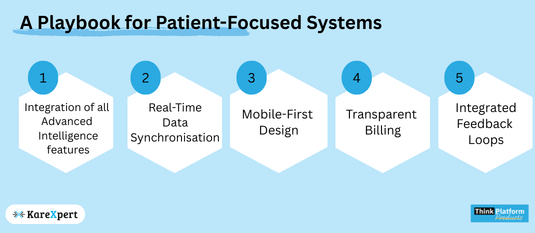
1. Integration of all Advanced Intelligence features
Best-in-class software encapsulated in a Unified Patient Interface. Don’t make patients juggle five different logins.
2. Real-Time Data Synchronisation
Labs, radiology, pharmacy, and clinical teams should operate on the same active data.
3. Mobile-First Design
Your systems must work perfectly on smartphones — because that’s where your patients are.
4. Transparent Billing
Surprise bills undermine trust. Systems should deliver real-time billing summaries.
5. Integrated Feedback Loops
Expect complaints, don’t wait for them. Use that data to inform engagement and anticipate disconnection.
The Issue: More Tech or Better Tech?
You don’t need more tools; you need smarter ones. Adding layers on top of one another only creates more confusion and less communication. The goal is not to digitize every corner of the hospital — it’s to create a cohesive, intuitive, human-centered digital experience.
Last Thought: Loyalty Is a System Thing
Patients may not remember what you did, but they remember how you made them feel — and those feelings are shaped as much by your workflows as by your bedside manner.
In a world where expectations are high and digital maturity is growing, hospitals cannot simply provide care. They must adapt.
And sometimes, that begins not with retraining your employees, but with replacing your systems.
Because if patients are going, don’t just look in your waiting room.
Look at your tech stack.
That’s where the mass exodus starts.