
Inside the Metrics: The 7 KPIs That Will Define Hospital Success in 2025

As the healthcare landscape is dramatically transforming, the ranking of hospitals is no longer determined by patient volume or bed strength. Success in 2025 will be driven by purposeful, measurable results across clinical, operational and financial measures. Metrics that once resided in backend dashboards will suddenly impact real-time decisions, patient journeys and strategic investments. In this article, we go through the seven KPIs that will shape the definition of a high-performing hospital in the upcoming year—and why each one matters, now more than ever.
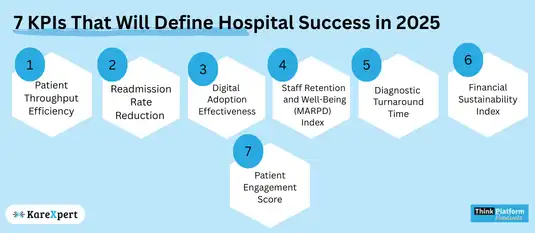
1. Patient Throughput Efficiency
No longer does bed occupancy serve as the sole barometer of capacity. The metric of patient throughput—how efficiently a hospital moves patients through the system from admission to discharge—will now be the focal point. In 2025, all the top-performing hospitals will be eliminating bottlenecks in the emergency department, streamlining OT activities, and limiting stagnation in getting surgical patients discharged.
Efficient throughput not only increases bed availability; it also drives overall patient experience and outcomes. An efficient system will permit early interventions, decrease waiting times in the clinic, and minimize burnout for clinicians.
Key Sub-Metrics:
– Time from triage to treatment
– Average length of stay (ALOS)
– Interval from clinical resolution to discharge
2. Readmission Rate Reduction
As the focus moves toward value-based care, getting paid won’t just depend on how many patients someone treats at a hospital but how well they are treated. A cautionary sign is when patients experience readmissions within 30 days of being discharged, which may indicate missed opportunities in continuity of care and discharge planning and education.
In 2025, hospitals that leverage predictive analytics to identify at-risk patients and improve post-discharge care pathways will excel compared to their peers.
Key Sub-Metrics:
– 30-day readmission rates, by condition
– Compliance with follow-up appointments
– Outreach to patients after discharge
3. Digital Adoption Effectiveness
The race towards digitization has progressed from mere adoption to intelligent usage. Simply having an EHR or HIMS is no longer sufficient; success hinges on how easily staff can achieve success and value through these systems.
In 2025, hospitals will track how often their systems are functioning as intended. KPIs such as time-to-chart completion, percentage of digital order entry vs. manual, and data sharing across departments will highlight where digital friction still exists.
Key Sub-Metrics:
– Number of clicks per workflow
– Time spent on documentation
– Reliance on digital tools vs. manual processes
4. Staff Retention and Well-Being (MARPD) Index
Healthcare’s most valuable asset is human capital. A hospital’s success—in 2025 and beyond—will hinge heavily on the morale, engagement, and retention of its clinicians and staff. Burnout has reached a crisis point, and neglecting staff well-being will exact a high operational and reputational toll.
Hospitals that embrace ergonomic scheduling, mental health support, and solid career growth tracks will not only keep talent but also improve quality of care and patient trust.
Key Sub-Metrics:
– Department turnover rate of employees
– Average absenteeism
– Results of staff engagement and wellness surveys
5. Diagnostic Turnaround Time
Diagnostic precision will remain the prime currency of quality care, and speeding through lab results, imaging and pathology will be a competitive differentiator. In 2025, hospitals will invest in lab automation, real-time data synchronization, and AI-assisted reporting to narrow this window.
Rapid diagnostics will enable quicker interventions, shorter hospital stays, and better patient outcomes, particularly in emergency and oncology departments.
Key Sub-Metrics:
– Average time for delivery of lab results
– Reporting time of radiology investigations
– Rates of diagnostic accuracy with AI-assistance
6. Financial Sustainability Index
Cost pressures will mount, but hospitals that can create sustainable financial models through more efficient operations coupled with diversified revenue streams will prosper. This means cutting back on waste, tapping preventive care models, and billing-cycle efficiency.
In 2025, the measure of financial health will be not only profitability but adaptability. When cash flows are tight, predictive budgeting and ROI-driven technology investments will keep hospitals competitive.
Key Sub-Metrics:
– Operating margin
– Revenue cycle duration
– Cost-per-case vs. revenue-per-case
7. Patient Engagement Score
Patient experience is transitioning from hotel-style amenities to meaningful engagement. Whether a patient is navigating the pre-admission, admission, or post-discharge stages of their care, they expect open lines of communication, digital touchpoints, and participatory approaches to treatment.
Hospitals that focus on real-time feedback, deploy mobile-first interfaces, and help patients become active partners in their care by providing ongoing education will earn greater trust and loyalty.
Key Sub-Metrics:
– Rate of usage from scheduled appointment
– Responsiveness to patient feedback
– Ratings for app engagement and satisfaction
Shift From Measurement to Momentum
Each of these KPIs is not just a measure, it is a fundamental change in how hospitals operate, the way hospitals pivot, and the standard of hospital leadership by 2025. No hospital will be proficient in all of them overnight, but those that start to orient systems, teams, and technology toward these metrics will be better prepared to survive.
Healthcare winners are those that are proactive instead of reactive. These seven KPIs provide hospitals a roadmap—not just to gauge their progress, but to define a system that provides superior care, builds resilient operations, and stays true to a new normal in expectations.
Because in 2025, success won’t be a fixed score, it will be a dynamic system that knows what to measure and what actions to take.